
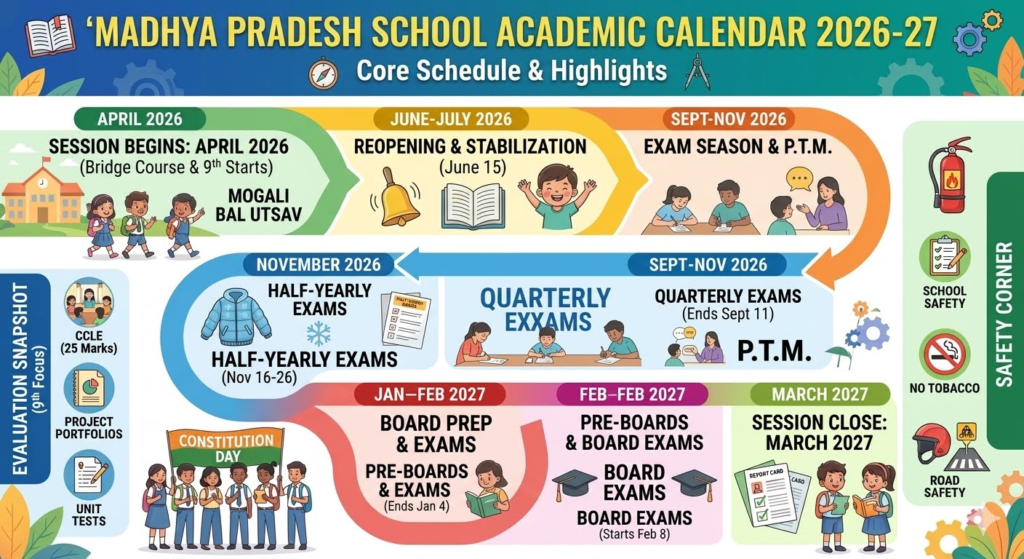
Academic Calendar 2026-27- The Directorate of Public Instruction (DPI), Government of Madhya Pradesh, has officially released the comprehensive School Academic Calendar for the academic session 2026-27 (p. 1). Issued under the guidance of Chief Minister Dr. Mohan Yadav and School Education Minister Shri Uday Pratap Singh, this detailed almanac provides a structured roadmap for government high schools and higher secondary institutions across the state (p. 1). The calendar meticulously outlines the monthly syllabus distribution, exact exam schedules, administrative mandates, school safety protocols, and continuous co-curricular evaluation targets designed to elevate the state’s educational standards (pp. 1-2, 12).
Month-by-Month Academic and Co-curricular Breakdown
Academic Calendar 2026-27- April 2026: Commencement of Session and Fundamental Revisions
The academic session 2026-27 officially begins on April 1, 2026, marking the launch of the state’s flagship ‘School Chalo Abhiyan’ and student enrollment drives running until April 10 (p. 1). A dedicated Bridge Course commences on April 6 specifically designed for students transitioning from Class 8 into Class 9 to address baseline learning gaps in foundational subjects like Hindi, English, and Mathematics (pp. 1, 7). Schools are instructed to focus heavily on activity-based learning and execute physical verifications of library funds, stock assets, and laboratories (p. 1). Monthly unit tests are scheduled for April 29 and April 30 (p. 1).
Academic Calendar 2026-27- May and June 2026: Summer Engagement and Institutional Reopening
Summer vacation for both teachers and students formally begins on May 1, 2026 (p. 3). Throughout May, schools host morning and evening summer camps focusing on arts, theater, pottery, and English spoken-language development (p. 3). Intensive campus maintenance, furniture repairs, and laboratory upgrades take place between May 5 and May 31 (p. 3).
Teachers officially return to campuses on June 1, 2026, to draft comprehensive lesson plans and undergo specialized training on the dynamic life skills curriculum (p. 5). Regular classes for students resume on June 15, 2026, alongside Parent-Teacher Association (PTA) meetings to confirm a target of 100% student enrollment across all grades by the end of the month (p. 5). Career counseling weeks are conducted for senior students from June 22 to June 27 (p. 5).
JAcademic Calendar 2026-27- uly 2026: Core Academic Stabilization and Board Prep
July marks the stabilization of standard timetables, featuring a total of 27 working days (p. 7). The Class 9 foundational Bridge Course formally concludes on July 31, 2026 (p. 7). Teachers of Class 10 are mandated to form custom annual revision blueprints to finish board exam syllabi ahead of schedule (p. 7). Specialized co-curricular platforms like the ‘Mogali Bal Utsav’ launch their school-level contests on July 7, followed by cluster-level rounds on July 14 (p. 7).
Academic Calendar 2026-27- August 2026: Intensive Academic Evaluation and State Competitions
Schools function for 23 educational days in August, introducing structural subject integrations across STEM and humanities streams (pp. 9-10). High-level state events activate their preliminary tiers, including the Rashtriya Kala Utsav block rounds on August 10 and district rounds on August 18 (p. 9). The school-level tier for the Balrang festival occurs on August 2, advancing to development blocks by August 8 and reaching the district level by August 29 (p. 9).
Academic Calendar 2026-27- September 2026: First Terminal Evaluation (Quarterly Exams)
September 2026 serves as a major evaluation milestone with the execution of the Quarterly Examinations (त्रैमासिक परीक्षा) finishing on September 11 (p. 11). Following the evaluation, schools must open answer scripts for student review and organize mandatory parent-teacher meets to report individual progress, attendance, and conceptual bottlenecks (p. 11). Diagnostic and remedial learning circles are deployed immediately for underperforming students based on their quarterly exam metrics (p. 11).
Academic Calendar 2026-27- October and November 2026: Festival Breaks and Half-Yearly Examinations
October features the regional Science Fairs (विज्ञान मेला), showcasing student-led model exhibitions and experimental theater (p. 3). The iconic state-level tier of the Mogali Bal Utsav occurs within the Pench National Park in Seoni from October 22 to October 24 (pp. 4, 13).
November hosts 20 operational educational days due to extended Deepawali holidays (p. 15). The critical state-level Half-Yearly Examinations (अर्द्धवार्षिक परीक्षा) commence on November 16 and conclude on November 26 (p. 15). November 26 is celebrated as Constitution Day, featuring community reading of the Preamble and student debates regarding constitutional mandates (p. 15).
Academic Calendar 2026-27- December 2026 and January 2027: Pre-Boards and Winter Breaks
December focuses heavily on evaluating half-yearly exam outcomes and rectifying learning discrepancies (p. 17). Winter break triggers at the close of the month, lasting from December 31 through January 4, 2027 (p. 17).
January shifts institutional focus entirely toward examination readiness (p. 19). Board-bound students of Class 10 and Class 12 face rigorous Pre-Board Evaluations running from January 5 to January 13, 2027 (p. 19). Subject educators are ordered to analyze pre-board score sheets to devise student-specific revision strategies and actively solve the previous five years of board question banks (p. 19).
Academic Calendar 2026-27- February and March 2027: Final Board Schedules and Session Wrap-up
February 2027 marks the culmination of the academic year (p. 21). The official Board Examinations are slated to tentatively begin on February 8, 2027, followed by the activation of local annual school evaluations on February 22 (p. 21).
March 2027 acts as the closing phase of the session, delivering final promotional report cards via centralized PTA conventions (p. 23). Financial audits, physical infrastructure verifications, and staff performance recording are executed by institutional heads (p. 23). To secure an advanced start for the next academic cycle, text-book distributions and preliminary enrollment milestones for the 2027-28 session operate between March 20 and March 31, 2027 (p. 23).
Continuous and Comprehensive Learning Evaluation (CCLE) & Marking System
The marking scheme designated by the Board of Secondary Education, Madhya Pradesh, incorporates co-curricular participation directly into academic scoring files (p. 24). For Class 9 students, a distinct 25-mark segment is reserved for continuous evaluation parameters outside of core written exams (p. 24):
- Quarterly Written Tests: 5 Assigned Marks (p. 24)
- Half-Yearly Written Tests: 5 Assigned Marks (p. 24)
- CCLE & Project Portfolios: 15 Assigned Marks (p. 24)
Every Saturday, the initial three lecture segments are strictly dedicated to Bal Sabha structures organized around specific developmental themes (pp. 7, 9, 24). July focuses on the ‘Sabal Bharat’ theme, exploring health, fitness, and nutritional awareness through essay and extempore speech exercises (p. 24). August pivots to the ‘Gauravmayi Bharat’ banner, highlighting traditional value structures, freedom struggles, and historic figures via group debates (pp. 9, 24). September introduces the ‘Prakhar Bharat’ template, emphasizing science models and empirical thinking (pp. 11, 24). October implements the ‘Pratibhashali Bharat’ theme, prioritizing digital paper presentations, programming logic, and cultural arts (pp. 13, 24).
Mandated Safety Protocols and Institutional Guidelines
School Safety Annual Calendar
To ensure a secure environment, the calendar introduces a mandatory, month-wise school protection workflow (p. 12):
- April to June: Formulation of custom School Safety Plans, structural assessments of buildings, and prehistoric monsoon risk charting to counter waterlogging or loose wiring (p. 12).
- July & August: Evacuation simulations for flood hazards, comprehensive review of sanitation hygiene, and reactive drills for earthquake contingencies (p. 12).
- September & October: Focused orientation circles discussing child protection clauses, POCSO compliance, anti-bullying guidelines, and social-emotional safety metrics (p. 12).
- November to January: Execution of digital safety frameworks, cybersecurity checks on campus ICT assets, and physical inspection of firefighting devices (p. 12).
Academic Calendar 2026-27- Tobacco-Free Educational Institutions (ToFEI) Mandates
All state educational centers are bound to strict anti-tobacco enforcement policies (p. 6). Clear restriction signage must guard the main entrance gates and peripheral boundary walls (p. 6). Sale or trade of tobacco products is legally prohibited within a strict 100-meter radius of any school gate (p. 6). Campus administrators must assign designated Tobacco Monitors and organize structural awareness seminars every six months (p. 6).
General Road Safety Instructions
The calendar incorporates mandatory transit protocols for all institutional members (p. 6). Students under the age of 18 are prohibited from operating motorized vehicles to school (p. 6). Commuters utilizing two-wheelers must wear protective helmets, while car occupants must remain buckled with seat belts (p. 6). Pedestrians are advised to strictly utilize sidewalk walkways and cross traffic lanes only via designated zebra lines during red signal halts (p. 6).
View and Download Academic Calendar 2026-27

